

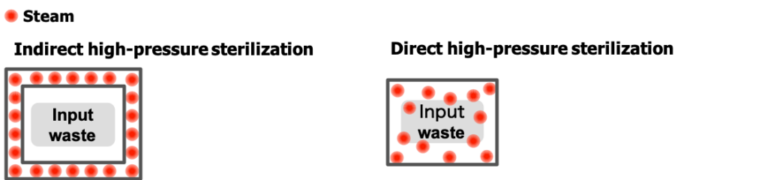
ERS fulfills 2 ways of sterilization; direct high-pressure sterilization and indirect high-pressure sterilization. The direct high-pressure sterilization is a common way which is also used for a conventional autoclave. In this direct way, moist heat in the form of saturated steam under pressure directly touches input waste inside the device. What makes ERS different from the conventional autoclave is the indirect sterilization method ERS can realize. This indirect method is exercised by heating ERS’s machine body by saturated steam at 2 atmosphere, keeping inside temperature to be 121 ℃ without wetting input waste.
 Inputting the wastes and discharging the outputs: 1 to several staff (It depends on the kind of input wastes)
Operating the machine: Assigning 1 staff is enough to monitor the operation by visually checking the agitation status inside ERS’s main body and by checking the indicators.
No. The microbe planted inside the machine naturally grows and increases its population without replenishment.
Harmful germs such as Bacillus coli will be killed by heating at 65℃ through fermentation and drying process of ERS treatment.
Harmful germs such as Bacillus coli will be killed by heating at 65℃ through fermentation and drying process of ERS treatment.
A big difference between ERS process and common composting process is the time length of processing to generate fermented organic matter.
ERS: 2 to 4 hours
Composting: More than 1 month
It is a high speed fermentation and drying technology using indigenous microbes and mechanical depressurization.
The microbes planted inside the main body of ERS generate fermentation heat well under 50 to 60 ℃.
Internal pressure of ERS main body is mechanically reduced to get the boiling temperature down to 50 to 70 ℃ to expedite the fermentation and evaporation of water content of the input waste.
Two types of maintenance-Daily maintenance done internally and Annual checkup by the manufacturer.